kazuo ishiguro and david mitchell: among giants and ghosts

Hello, readers.

IMG_7198

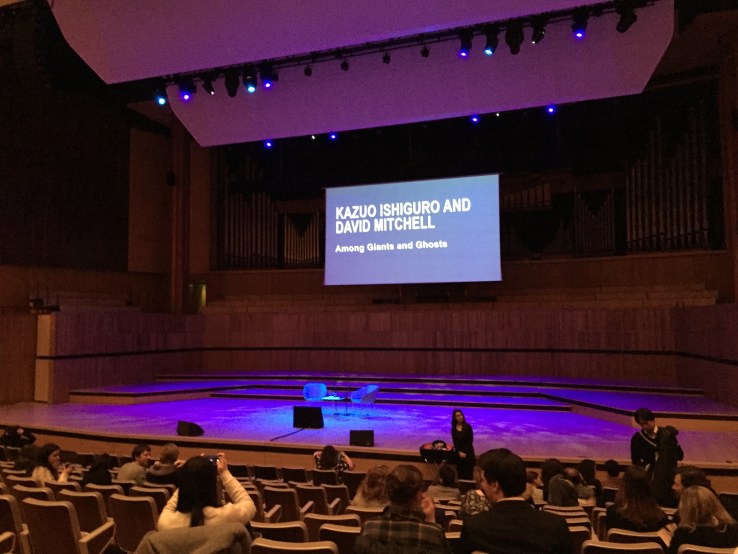
Last Wednessay, as part of a week-long cavalcade of birthday wonderfulness, EG took me to see Kazuo Ishiguro and David Mitchell in conversation at the Royal Festival Hall, part of the sprawling Southbank Centre located here in London along the Thames.

They sat across from each other, angled toward us, and spoke at length, and in glorious loops, about, among other things, stolen livers, almost beautiful Japanese ghosts, swordplay, film vs. writing, fear and courage, dungeons and dragons, the recklessness of youth, and the one thing Kazuo Ishiguro learned from War & Peace1.

They divided their conversation, for the most part otherwise improvised, among three topics, each introduced by a film clip2

I particularly enjoyed the way that Ishiguro ignored, throughout the evening, all of those beautifully appropriate hints for segues delivered by David Mitchell.

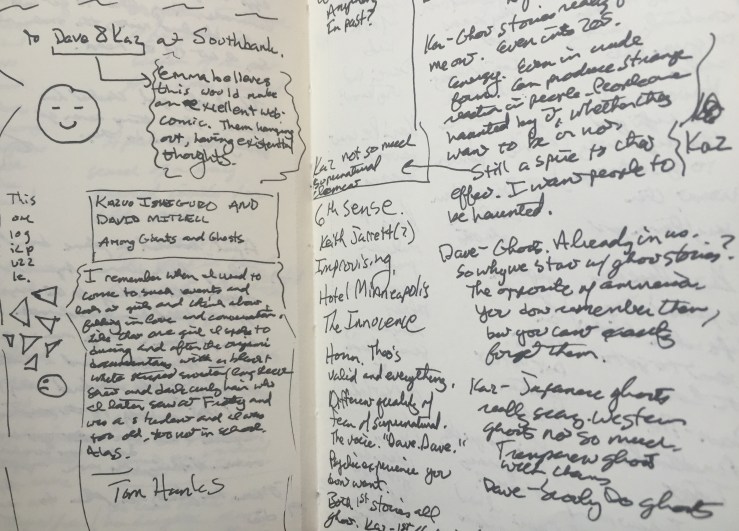
Here is a picture of some of my notes from the evening:
dave&katz_notes

And here are some selections of those notes typed out such that they might appear somewhat more legible-like. (note: the quotes below should be read as a doubtful combination of scribbled notes, memory, and imagination).

ghosts3

different qualities of fear

The evening began with David Mitchell telling a story first told to him by his brother, of a boy named Dave who stole his dead uncle’s liver to sell to the butcher for money with which to buy sweets. In the end, the dead uncle creeps into the house, and up the stairs, and steals Dave’s liver and replaces it with sweets.

Kazuo Ishiguro responded that it was a really good story until it became horror.

KI: Horror. That’s valid and everything. But there is a different quality of fear with the supernatural. The story worked best at that moment of the voice calling out from the stairwell, “Dave. Dave.”

DM: When the ghost loses its ectoplasmic liminality, something more rational kicks in. Writing a ghost story is a high wire act.

He spoke, then, Ishiguro did, of the psychic experience you don’t want. Of how little he feared his liver being torn out, of whatever the ghost might do to you, and how much he feared reality’s distortion, of the loss of trust in, and control of, his senses.

KI: I don’t mind the horrible stuff. I’m afraid of waking up in the middle of the night and seeing the apparition. There’s an energy in ghost stories. Even in a crude form they can produce a strange reaction in people. People are haunted by them whether they want to be or not. I still aspire to that effect. I want people to be haunted.

japanese and western ghosts

KI: Japanese ghosts are really scary. Western ghosts not so much. Transparent people with chains.

DM: Scooby-doo ghosts.

KI:Japanese ghosts represent emotions so powerful that the normal physical laws don’t apply to them.

DI: They’re implacable. Like a sadistic mother. You’re constantly having to guess the rules. In folk tales, you have to ask the right god in the right way to get what you want, and then you must say thank you.

earliest stories

Also. It turns out that, for both writers, their earliest stories were ghost stories. The first four of Ishiguro’s published stories, in fact.

dungeons & dragons

Just so you know, David Mitchell divides writers into ex-D&D players and non-ex-D&D players. Kazuo Ishiguro didn’t know what the hell it was. David Mitchell said to ask Michael Chabon, a former dungeon master.

action on the page 4

before we begin

I should point out there are few things more magnificent than listening to Kazuo Ishiguro refer to western-style sword-fighting as clinky, clonky affairs in which one has long conversations.

do you feel we are second best to cinema

After showing us a very brief, and very tense, Japanese sword-down, and asking David Mitchell the above question, Mitchell responded that really it depended on what result you desired.

DM: Once the gun goes off, the tension’s gone.

KI: Perhaps it’s psychological build-up, that’s where we have an advantage. Like in that moment where Kurosawa’s characters are staring at each other. You have to film an actor from the outside. Unless you do something very weird.

DM: Action’s actually kind of dull on the page. Rosemary Sutcliffe. I loved her fights. I remembered them as 20 pages long, but, when I looked back, whole battles, on which rested the fate of the world, lasted less than a page-and-a-half.

peculiarly fearlessness

KI: You are peculiarly fearless. Do you have an idea that this setting or genre is so alien to my experience, that you don’t carry on?

DM: There’s a subdivision between genre and material. I’m attracted to genres that I’m not familiar with. As for material, you can always do it. But you have to do it sideways. Now, I wouldn’t do an American voice. A Brit who lived in the U.S. a long time, perhaps. Or a Canadian. a micro-note off is worse than being a whole octave off

KI: Would you write an African-american character?

DM: I’ve read too much Ta-Nehisi Coates to attempt that.

notebooks

Kazuo Ishiguro has been keeping a notebook since 1981 in which he writes down all his ideas. 1981 is the year I was born. That means I am as old as Kazuo Ishiguro’s ideas.

buried giants, lost settings

KI: I backed off setting the book, Buried Giant, in Bosnia.

DM: I wouldn’t call that a cop-out. Just very sideways.

the doubtfulness of reality 5

DM: Why are so many of your characters not sure if they can trust their minds?

I don’t remember exactly how Kazuo Ishiguro answered this question, and my notes, such as they are, transition into WHAT AN AMAZING VERB REALIZED IS.

KI: And I realized. It’s a great verb to expedite things. You can use it in strange and promiscuous ways.

DM:To realize something includes an act of erasure. Cool verb. I’ve underrated it all my life.

questions and answers

DM: What’s the strangest thing you’ve ever been asked to sign?

KI: Nothing particularly strange. Why? Have you?

DM: A midriff. Don’t tell my wife. Later she got a tattoo. Maybe I shouldn’t have done that.

KI: I have been asked some pretty strange questions. Once, a woman stood up and told me, at extreme length, the situation at her office, and then she asked if I thought she should resign.

In a remarkable display of unconscious gender bias, all questions asked by the audience came from people identifying as female.

Here are the five questions asked and their respective answers.

  1. If you looked behind you right now and saw a ghost, what would it look like?

    KI: A sneaky way to ask a very personal question.

    DM: Myself, aged 80.

    KI: (incredulous)That’s not very scary. Oh, look. That’s just me. I guess that’s slightly disconcerting.

    Ishiguro then considered his own answer.

    KI: Ghosts of children. Or. One of those almost beautiful women ghosts, but they’re not. They’re very scary.

  2. Could you talk about how you come to your endings? Because, Mr. Mitchell, it seems as though your books are so beautifully constructed, and Mr. Ishiguro, it seems the endings for your books grow organically from the story as it unfolds.

    KI: I always have the endings before I start. I know absolutely the emotion I want to end on.

    DM: I never know. A novel for me is like a road journey through the alphabet. I like X, Y, and Z to be murky. I want my endings to have a retrospective logic.

    KI: How far do you go before you know the ending? Quite near the end?

    DM: It has happened, yes. The writing of the book tells me how it will end.

    It gives me great comfort, as a writer and a reader, to know that the woman who asked this question experienced, from reading these two author’s books, the exact opposite sensation of the two writers writing their books. As much as we may think we know, we don’t.

    Then Ishiguro and Mitchell discussed whether or not Ishiguro was cheating when he wrote.

    KI: I do the same thing in miniature. Often, an image, scene, or moment, drops in my head. Is it okay to work backward?

    DM: I’m going to conjure the spirit of Ian McKellan here and say, “My dear boy, that’s all writing is.” I often see an F that is radioactive with rightness, and I try to figure out what D and E will get me to F?

  3. What do you do when you need to take a break from writing?

    DM: I go for walks. I speak dialogue aloud. In the small village where I live, people probably see me as the town kook.

    KI: I escape into music, the non-verbal world. When I watch a movie, I’m still thinking with my writing brain. Oh, that’s a false enemy.

  4. Who would else would you care to do an evening like this with?

    DM: Joseph Conrad

    KI: Dostoevsky. He’d be a lot of fun.

  5. Do you believe that success, or popularity, makes it harder for you to be authentic?

    Here, in this answer, we saw something we saw throughout the night, namely, Kazuo Ishiguro’s fantastic deftness at redirecting questions at David Mitchell while simultaneously transforming them into compliments.

    KI: David, this is what I was getting at before. In Number9Dream, you used the English vernacular so freely while writing from the point-of-view of a Japanese boy. It’s not subtitled English. I don’t think I’ve seen since or before a writer dive write in to a foreign consciousness, so fully realized. So fully characterized.

    DM: I was my own translator in that book.

    KI: How do you hint at a second language behind the 1st? You do it so well, or maybe so recklessly.

    DM: I am a first-person present tense junkie. You can only have subtitles in past tense. I followed my instinct. You start to question that instinct as you age

    KI: Yes. More cowardly.

fear and courage

KI: There’s a theme to this evening, I think. Fear and courage. Issues in writing. You have to be daring. Is fear too big a word?

DM: We live in a tiny world of calculated risks. You have to decide where courage will turn into hubris and get as close to that line as possible. Then write down descriptions of what seems so hard. Often you’ll find solutions in the description of what seems impossible.

And that, was the end, of that.

Thanks for reading.

Happy whatever day this is where you are, readers.


ttfn.


  1. Ishiguro said one thing he learned from this was that before a great battle it serves one well to send a character up to a high place and have them look down at the battlefield. He said he saw the same thing in Number9Dream. ↩︎
  2. Perhaps in response to, or as planned, the evening’s use of film clips to introduce the two writers, and their topics, led to a fascinating discussion of what advantages and disadvantages each art form—film and writing—has in respect to the other. ↩︎
  3. clips shown: The Sixth Sense & The Innocence ↩︎
  4. final stand-off from Kurosawa film, possibly Yojimbo ↩︎
  5. clip from Forest of the Dead, that one episode of Doctor Who where Donna is saved by a computer and life is but a dream ↩︎

storyological

Hello, readers.

I’m now the co-host and producer of a podcast.

It’s called Storyological.

storyological new ident smallest

It’s about stories, life, the universe, and everything.

This nice lady did the art and is also my co-host.

We’re pretty proud of it.

You should give it a listen sometime.

The first episode is up here. We talked about the stories “Angel, Monster, Man” by Sam J. Miller and “The Time Travel Club” by Charlie Jane Anders.

I hope you like it.

Happy conversations, readers.


ttfn.

fearfully and wonderfully made

Hello, readers.

Earlier today, I watched this clip from The Late Show with Stephen Colbert.

In it, television pastor and possible Tyler Durden protégé, Joel Osteen refers to a bible quote that speaks of the works of god as fearfully and wonderfully made.

I’ve started the process of thinking about writing a new story. This involves listening to a lot of different voices in my head and writing them down without editing. There’s always a moment in the process of writing where something like a story begins to take shape in the writer’s head and it’s so awesome, but then a part of them wants to stop because they’re scared that in the process of excavating the story from their head and onto the page, it will all fall apart.

But, well.

Fearfully and wonderfully.

Maybe that’s the only way to make things that matter.

Happy Wednesday, readers.


ttfn.

dinosaurs dancing forever

Dear readers,

Today, it’s clear and cool and windy. I feel elated to have finished a second draft of my book and certain that it’s not good enough. Also, two days ago I worried over the possibility that no one would say anything at my funeral. Possibly because I outlived everyone? Or, possibly, because so many of my friendships exist with people that live on the other side of oceans. Probably the best solution is to not die. I don’t think anyone’s figured that out, yet. People have been working on it for some time, though. Mark Twain once said that, “life would be infinitely happier if we could only be born at the age of 80 and gradually approach 18.”

In other news, EG and I have decided to do a podcast in which we drink cocktails and talk about short stories and life and stuff. We’ve already recorded several. Look for those to exist in a form to which you can listen soon.

Or, well, don’t look for it. Best to keep your mind on the present, really. The future will get here soon enough.

Meanwhile, the past keeps catching up with us, as well. Did you know dinosaurs danced? Neither did I. But, very possibly, they did.

Happy Tuesday, readers.


ttfn.

bright, echoing sadness

Hello, readers.

Last night, we visited The Forge and listened to Jo Rose and Samantha Crain. The Forge, with its precision arrangement of pale wood, resembles everything you generally expect from a classy, jazzy, sort of place. With the addition of, this being England, some cider on tap. So far as I know, cider on tap is not a phrase familiar to most Americans, particularly, the classy, jazzy ones.

Jo Rose rode the train down from Manchester. He wore a jumper and slacks. He played a wise guitar. His banter was gentle, and low-key, and his songs full of bright, echoing sadness accompanied by the occasional dark tremble from that carefully strummed and very wise guitar. He remarked, on more than one occasion, that this crowd filled the space with the sort of classy silence that renders it very difficult to discern whether one’s show is going well or poorly. If Jo is reading this, I can help with that. It went well.

Samantha Crain did not, so far as I know, ride the train down from Manchester. My sister saw her in Nashville and told us that we should see her. She wore purple tights and a subdued sort of cosmic jumper. On stage, she was joined by a fellow with a guitar and a drummer with, well, drums. Her songs rocked with heartache and care and want. I loved it.

Tomorrow, I will attempt to buy Beirut tickets.

Wish me luck, readers.

ttfn.

june do

Hello, readers.

Here are things I would like to do this month.

Finish the second draft of my book.
Get married.
Hang out with my sister and friends.
Travel through Paris.
Finish a short story or two.
Critique a friend’s book.

So, if you don’t see me on the blog, this is why.

Hope it’s an excellent month for you all.

See you in the future.

love.
ttfn.

on genre, the infinite cloud, and other things

Hello, readers.

Welcome to Friday. Many things are happening. Which is, of course, in the nature of things. If things didn’t happen then they wouldn’t even be things. Which is a weird way to think, actually, as it leads me to look at the pillow leaning against the arm of this couch and think: “That pillow is a happening pillow.”

Here are things.

Thing 1:

Neil Gaiman and Kazuo Ishiguro on BBC4 talk genre fiction and the prejudices and wonders surrounding and contained therein, and, more awesomely, how they’ve evolved. Bask in the variety of English accents!!!

Also.

Here’s a review I wrote of Stories, a collection of genre-bending stories Gaiman co-edited.

Thing 2:

Google Photos launched. Unlimited, free storage for photos (up to 16mb per image) and videos (up to 1080p resolution). The cloud becomes infinite.

…you’ll be able to search for photos with simple keywords. It’s like your own personalized Google Image search. Looking for all the photos you’ve ever taken of your puppy? Just punch in “puppy.” Even more advanced searches like “kissing” returned accurate results in my early testing.

Google wants to organize and make sense of the world’s information. Giving the world a free space into which to put their information kind of helps with that.

Thing 3:

A fantastic TED talk, that’s really an interview and demonstration. John Hockenberry interviews Tom Shannon (painter of centrifugalism, sculptor of magnetism) about making art that visualizes the invisible world.

I love invisible things.

Thing 4:

John Scalzi’s very big, and very public, deal with Tor discussed in the Washington Post with an interview with John Scalzi.

Scalzi’s contract sets a very public precedent for other science fiction authors to use as a negotiating point, and it also gives him room to breathe: In addition to sequels to several of his most popular series, Scalzi pitched Tor three ideas for young adult novels, a genre he hasn’t worked in before.

Thing 5:

I like having 5 things. That is the fifth thing.

Enjoy your weekend, readers.

ttfn.

must see magic love horror

Hello, readers.

I’ve finished Neuromancer. I believe this counts for 8 additional sci-fi cred points (sfcp’s, as the kids call them, the ones in my head that I made up anyway).

Here are a few links of note for you, this Thursday, the ancient day of the god Thor and the slightly less ancient god of NBC’s Must See TV.

An awesome Storify put together by Alyssa Wong wherein she asks writers to send her their favorites of stories they’ve written, and share why they favor them so very much.
title

I sent Alyssa a link to this old gem, Some Things about Love, Magic, and Hair, which I wrote about the why’s and wherefore’s in Some Things About Some Things.

Stories, like love, are a kind of magic, even to the writers and lovers. Especially to them, maybe, because some part of them, like the magician, knows that everything around them is an illusion, a carefully orchestrated system of smoke and mirrors and forevers designed to conceal the truth—that the woman is still in one piece, that the flying man is held up by wires, and that love, however true it seems, sometimes lasts for only a month, a year, or a day.

An interview with Kelly Link by Helen Oyeyemi

I do reread books and stories, all the time. Often children’s books and ghost stories, especially anthologies of ghost stories. Stephen King’s novels or collections. I reread things that I loved, or that had a particular effect on me. I once asked a bunch of horror writers why it was still pleasurable to reread scary stories when their power to scare us has diminished. The writer Nick Mamatas said, “I read to feel a sense of dread.”

A great interview with one of my favorite writers. ^_^

A review of Uncanny Magazine’s 4th Volume, Come into the Valley, by Angel Cruz.

It’s all tied together by Tran Nguyen’s astonishing cover art, if anything a tribute to the untameable nature of science fiction and fantasy, and the possibilities within. If there was ever a time to start reading Uncanny Magazine, Volume 4 confirms is it, with stimulating and truly enjoyable fiction, and a strong developing nonfiction base.

Happy gods and television, readers.

ttfn.

nanaimo recipe

Hello, readers.

Here is a somewhat vegan, totally gluten-free, not too sweet variation on a canadian classic1 called, NANAIMO BARS, what I concocted with the help and suggestions of a friendly Canadian lady person.

Nanaimo bars being a three-layered stack of delicious equal parts crumbly, creamy, and chocolatey.
 
IMG_3703


a recipe for nanaimo


LAYER 1: the crumbly bottom

ingredients

1 egg

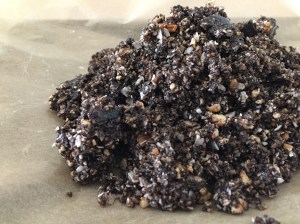
~230g butter/coconut butter2

90g cocoa powder3

250g oat biscuits

200g shredded coconut

100g chopped nuts

IMG_3592
method
  1. Heat the fat in a pan with the cocoa. Melt.
  2. Remove from the heat.
  3. Slowly beat the egg into the cocoa/fat mixture. Place back on stove. Cook for about 1 minute.
  4. Remove from heat. Mix in the crumbs/coconut/nuts mixture (one could add dried fruit if one wanted).
  5. Press into pan what lined with parchment paper and greased.


LAYER 2: the creamy, sweet middle

ingredients

2–5tbsp almond butter (instead of custard)4
180g–230g fat
some amount of maple syrup as sweetener

IMG_3597
method
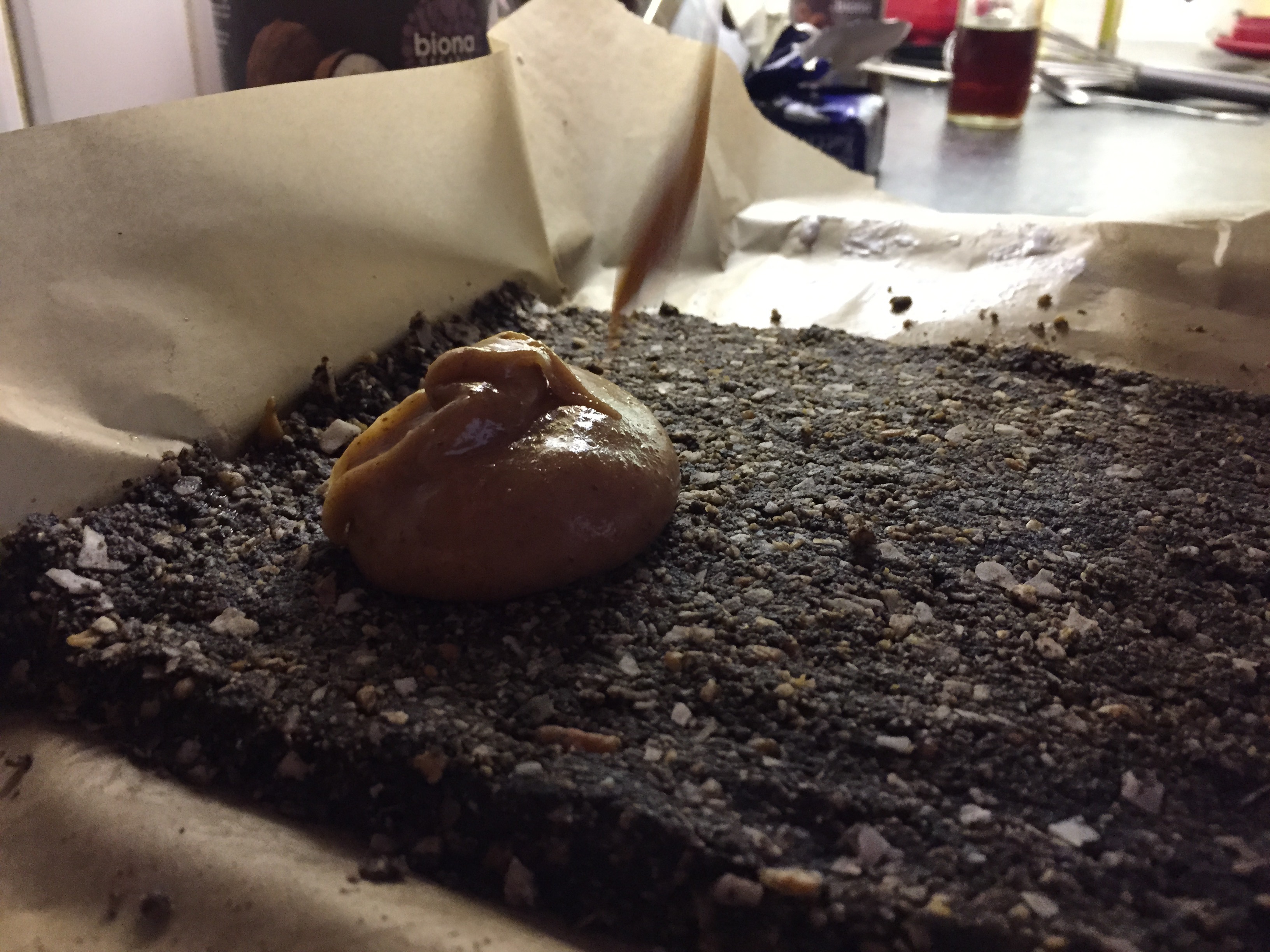
  1. Cream everything together into a creamy thing.
  2. Spread on top of the chilled crumbly layer.
  3. Chill for another 30 minutes to an hour.

IMG_3601 IMG_3607

LAYER 3: the chocolatey top

ingredients

4 oz dark chocolate
~1/2–1 tbsp fat

IMG_3702
method
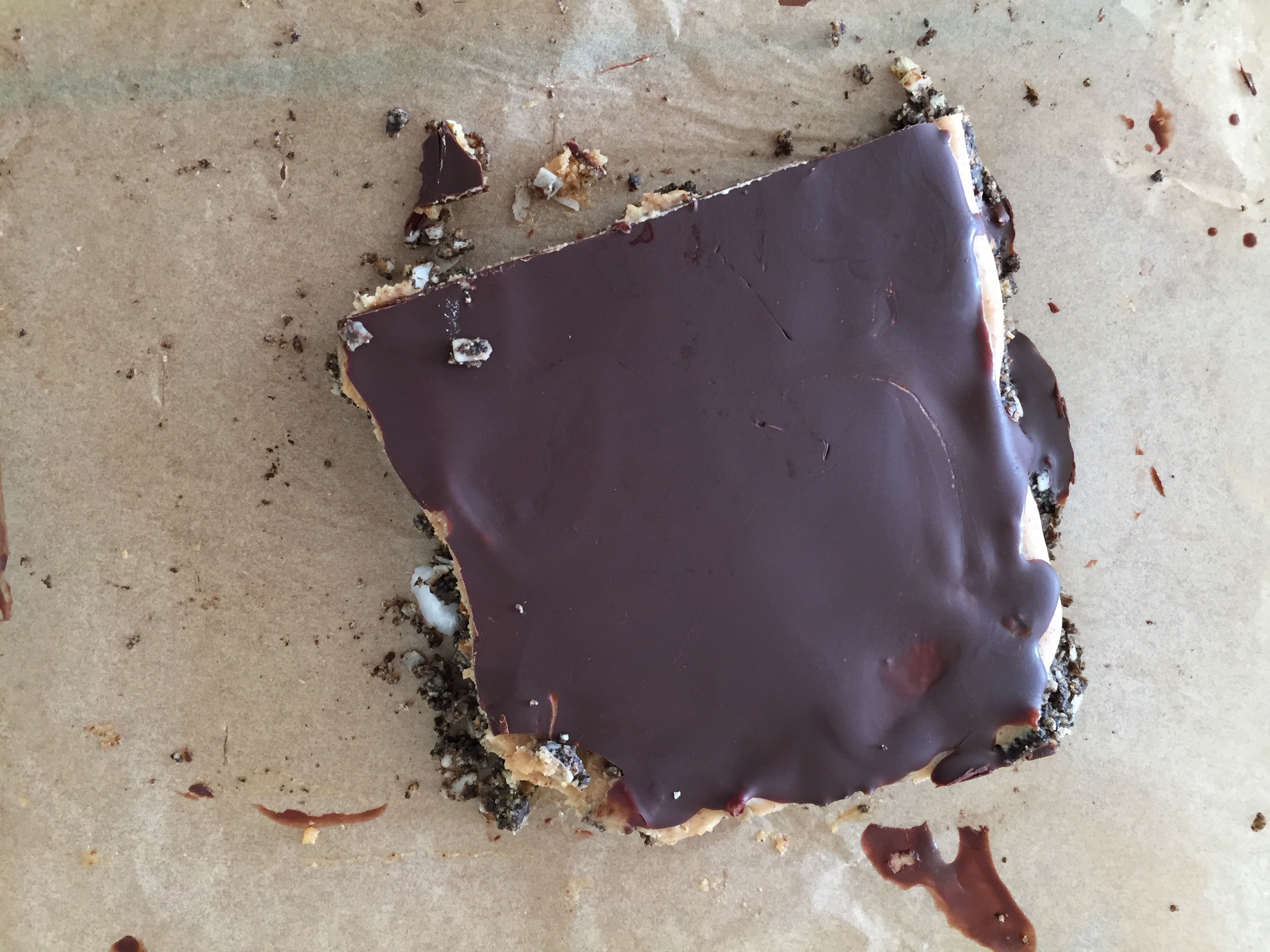
  1. Heat the fat in a double boiler with the chocolate. Melt.
  2. Remove from the heat.
  3. Top the middle layer
  4. Chill.
  5. For at least half an hour.
  6. Eat.

IMG_3701

Happy fooding, readers.


ttfn.

  1. Note: I halved all of these ingredients except for, well, the egg, which I didn’t. Also. You could make this totally vegan by substituting some egg-replacement and using vegan butter or just going full-on with the coconut oil/butter []
  2. As noted above, feel free to substitute more coconut butter/oil for the butter and see how it goes []
  3. Totally used carob powder cause had it on hand []
  4. A lot of nanaimo recipes call for whole milk, or cream, plus some custard to thicken it all up. I went straight for something already thick and creamy. []

the hope at the end of everything

Hello, readers.

There’s a famous quote I don’t quite remember that may be attributable to either Joss Whedon or Neil Gaiman, in regards to either Buffy or Coraline, respectively, which goes something like this: That she cried was not in any way meant as an indication of weakness, or how little bravery she possessed, but, on the contrary, it was a sign of her strength, of how much bravery she possessed, that in the depths of such sadness she chose to continue fighting.

I was reminded of this because of two articles.

A.O. Scott’s NYtimes review of Tomorrowland: ‘Tomorrowland,’ Brad Bird’s Lesson in Optimism

And Naomi Novik, writing at Tor.com: A New Reality: The Optimism of Zen Cho

A.O. Scott’s sums up his particular sadness with Tomorrowland–a sadness made all the sadder in light of his love of Brad Bird’s other works, especially Ratatouille– in his final passage:

False cheer can be just as insidious as easy despair. And the world hardly suffers from a shortage of empty encouragement, of sponsored inducements to emulate various dreamers and disrupters, of bland universal appeals to the power of individuality. “Tomorrowland” works entirely at that level, which is to say in the vocabulary of advertisement. Its idea of the future is abstract, theoretical and empty, and it can only fill in the blank space with exhortations to believe and to hope. But belief without content, without a critical picture of the world as it is, is really just propaganda. “Tomorrowland,” searching for incitements to dream, finds slogans and mistakes them for poetry.

Contrast this, with the beautiful way Novik captures the particular wonder of Zen Cho’s writing in a story like “The House of Aunts.”

Cho doesn’t airbrush away those inconvenient realities—her vampires really do eat people, and they really are dead. But they can still be people, and still have friends and go to university and fall in love, because that is delightful, and capturing that middle ground is what makes the story so satisfying. There is nothing of the grimdark here and also nothing of the plastic and fake. You’re allowed to feel uneasy about the eating of people going on in the background and you’re also allowed to like the characters and be with them in their story.

You feel as you read that the author wants you to be happy, even if she is not going to lie to you to make you feel more comfortable

So very true.

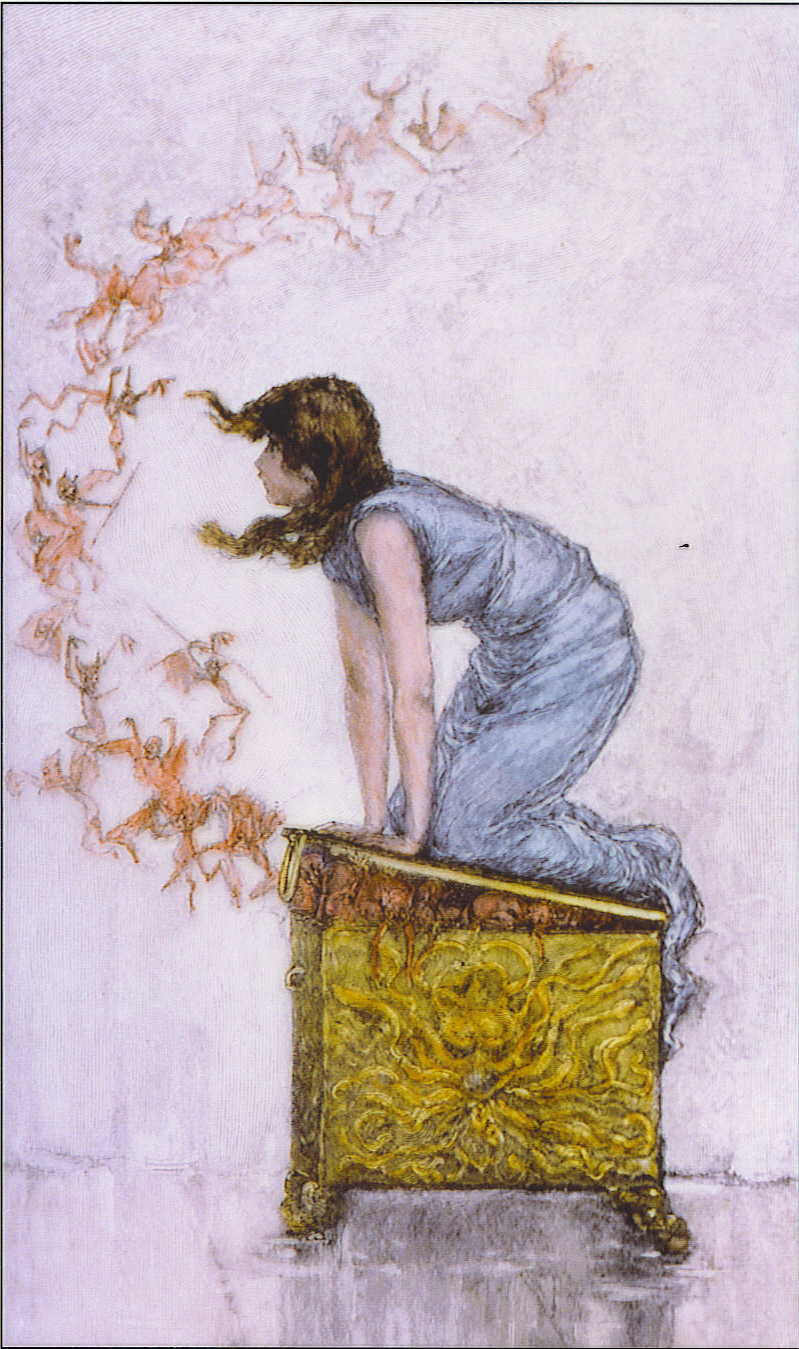
titleReaders, as you may or may not know, one of my favorite stories happens to be the story of Pandora and her box.

Most people know the first part of the story.

That a girl, upon opening a box, unleashed a myriad of evil magic and demons.

It is useful to remember, though, that in the darkest depths of her despair, after all hell had broken loose and she had arrived at the end of everything, there was, at the bottom of the box, only one thing remaining.

Hope.

It is a fact, sad or true or magical, I suppose, depending on your point of view, that the sharpest glimmer of hope might only be appreciated, might only truly be seen, in those moments marked by the deepest darkness.

But, truer still, maybe, is that hope, and the courage to hold on to it, to seek it out, to believe in it, only really matters at those moments. And so it’s only those stories that recognize the darkness which gives birth to hope and the tears which demonstrate strength, like those of Zen Cho, which prove both optimistic and brave.