a reflection of the real world

Hello, readers.

This blog may look a little different from now on.

There will still be posts like this, on occasion, where I speak to you directly.

But, for much of the time, and from henceforth, this particular blog will function, more or less, as a compendium of the stuff and things that rattle about the head of one particular human.

The name of this blog is the same as the name of one of my earlier blogs. The word ‘magnelephant’ comes from the play Cyrano de Bergerac. It means to be as magnificent as an elephant. Or possibly as magnetic.

I like the word ‘magnelephant’ because it means a great deal to me. Also, because, for the most part, it is entirely imaginary. Go ahead. Look it up.

To see my blogging in a previous life, readers, go here.

To see something inspirational, go here.

To see the future, close your eyes.


ttfn.

the end of the 20th century

A couple of articles in the Times 1 about Europe, nationalist movements, and the possibly opposing destinies of Angela Merkel and Marine Le Pen 2

Here.

Those who follow Ms. Merkel closely say that she is weary of grappling with Europe’s troubles, and that her close circle, always small, is more defensive and withdrawn after last year’s migrant crisis, which has weakened her politically. Still, she is under pressure to run for a fourth four-year term, a decision expected by early December.

“She’s the last one standing, and that makes her both strong and weak at the same time,” said Stefan Kornelius, one of her biographers and a political analyst for the daily newspaper Süddeutsche Zeitung. “She’s a pillar of stability, the last wall, and people want to lean against it.”

And here.

That revolution, they said, has overthrown what they called the “elites” — the mainstream news media and establishment politicians — who are in a tacit alliance.

The enthusiasm of the far right was in striking contrast to the coolness of Europe’s mainstream leaders to the week’s news. Some of them, like Chancellor Angela Merkel of Germany, offered veiled criticism even as they sent Mr. Trump pro forma letters of congratulation.

“It’s the emergence of a new world,” Ms. Le Pen said, after being the first to lay a wreath at the monument here to France’s World War I dead. “It’s the end of the 20th century.”


  1. The New Yorker has a funny style guide. From time to time, I copy it without care for consistency.
  2. Among other things, what an amazing name.

full coordination


From The Washington Post

Trump named Reince Priebus, the head of the Republican National Committee, as his chief of staff. In appointing Priebus, 44, Trump has brought into his White House a Washington insider who is viewed as broadly acceptable by vast swaths of the party, and he signaled a willingness to work within the establishment he assailed on the campaign trail.

But the president-elect sent an opposing signal by tapping Stephen K. Bannon, his combative campaign chief and former head of the incendiary Breitbart News, as his chief strategist and senior counselor. Bannon, 62, has openly attacked congressional leadership, taking particular aim at House Speaker Paul D. Ryan ­(R-Wis.) — who recommended Priebus for his new job.


Priebus, after the Access Hollywood video:

Nothing has changed in regard with our relationship,” Priebus said in a call with RNC committee members, according to sources on the call. “We are in full coordination with the Trump campaign. We have a great relationship with them. And we are going to continue to work together to make sure he wins in November.


Priebus, on Face the Natiom earlier this year, speaking about those Republicans pulling their support from Trump:

Those people need to get on board. And if they’re thinking they’re going to run again someday, you know, I think that we’re going to evaluate the process of the nomination process, and I don’t think it’s going to be that easy for them.


In choosing Reince Priebus—someone who supported his campaign throughout the election and threatened to punish those parts of the Republican establishment that opposed him—Trump signals a willingness to work with the establishment1.

Makes sense.

Update: From the Times, what amounts to a mini-profile of both Priebus and Bannon, as well as the strategies behind their appointment.

The simultaneous announcement and competing lines of authority are consistent with Mr. Trump’s management style in his businesses and in his campaign: creating rival power structures beneath him and encouraging them to battle it out.

It is also a reflection of who has the ear of the president-elect: his children, and especially his eldest daughter, Ivanka Trump, and her husband, Jared Kushner. Both had argued that the chief of staff job should not be held by someone too controversial, according to several people familiar with the decision-making inside the transition effort.


  1. I get that Preibus belongs to the establishment. But, so did Bannon, who, before taking over Breitbart, worked as an investment banker at Goldman Sachs. These aren’t mixed signals. This is the same signal. Demonstrate loyalty, particularly one tinged with vindictiveness towards those seen as disloyal, and you get rewarded.

same as it ever was


Derek Thompson, writing in The Atlantic:

But America is what we thought it was. It is still a 50-50 nation, dominated by negative partisanship, in which about half of the country will reliably vote to defeat the other half for the foreseeable future. It is still a nation of propositional pluralism—“send these, the homeless, tempest-tost to me”—crossed with ineradicable xenophobia—“go back to where you came from.” It is still a country teetering on the razor’s edge of both a social-democratic revolution and 1950s-era conservatism. That’s the country Americans knew we had at midnight Tuesday morning. And it’s the nation reflected in the votes tallied on Tuesday night.


Also. The Washington Post with a fantastic visualization of how few votes decided the election. Turns out:

This election was effectively decided by 107,000 people in these three states. Trump won the popular vote there by that combined amount. That amounts to 0.09 percent of all votes cast in this election.

That number of votes is about the same as the number of people who can pack into Michigan’s “Big House” stadium.

joi ito and barack obama in conversation with wired


Joi Ito, MIT Media Lab director, joined President Barack Obama in a far-reaching conversation about the role of technology led by Wired editor, Scott Dadich.

Here are some highlights. Note, this conversation occurred before the election.


Ito on his concerns concerning AI.

This may upset some of my students at MIT, but one of my concerns is that it’s been a predominately male gang of kids, mostly white, who are building the core computer science around AI, and they’re more comfortable talking to computers than to human beings. A lot of them feel that if they could just make that science-fiction, generalized AI, we wouldn’t have to worry about all the messy stuff like politics and society. They think machines will just figure it all out for us.

But they underestimate the difficulties, and I feel like this is the year that artificial intelligence becomes more than just a computer science problem. Everybody needs to understand that how AI behaves is important. In the Media Lab we use the term extended intelligence1. Because the question is, how do we build societal values into AI?


Obama on the government’s tech debt.

There is a whole bunch of work we have to do around getting government to be more customer friendly and making it at least as easy to file your taxes as it is to order a pizza or buy an airline ticket. Whether it’s encouraging people to vote or dislodging Big Data so that people can use it more easily or getting their forms processed online more simply—there’s a huge amount of work to drag the federal government and state governments and local governments into the 21st century. The gap between the talent in the federal government and the private sector is actually not wide at all. The technology gap, though, is massive. When I first got here I always imagined the Situation Room would be this supercool thing, like Tom Cruise in Minority Report, where he’d be moving around stuff. It’s not like that, at all. Particularly when it comes to hunting down terrorists on the other side of the globe, the movies display this omniscience that we possess somehow, and it’s—it’s just not there yet, and it has been drastically underfunded and not properly designed.


Obama on Star Trek.

I was a sucker for Star Trek when I was a kid. They were always fun to watch. What made the show lasting was it wasn’t actu­ally about technology. It was about values and relationships. Which is why it didn’t matter that the special effects were kind of cheesy and bad, right? They’d land on a planet and there are all these papier-mâché boulders. But it didn’t matter because it was really talking about a notion of a common humanity and a confidence in our ability to solve problems.

Star Trek, like any good story, says that we’re all complicated, and we’ve all got a little bit of Spock and a little bit of Kirk and a little bit of Scotty, maybe some Klingon in us, right? But that is what I mean about figuring it out. Part of figuring it out is being able to work across barriers and differences. There’s a certain faith in rationality, tempered by some humility. Which is true of the best art and true of the best science. The sense that we possess these incredible minds that we should use, and we’re still just scratching the surface, but we shouldn’t get too cocky. We should remind ourselves that there’s a lot of stuff we don’t know.


The saddest quote ever, perhaps, from Ito:

I think we’re in a golden period where people want to talk to each other. If we can make sure that the funding and the energy goes to support open sharing, there is a lot of upside. You can’t really get that good at it in a vacuum, and it’s still an international community for now.


The whole conversation is great, even if, on occasion, there’s this sinking feeling like you’re watching some once possible golden future quickly accelerate into the distant past.


  1. Extended intelligence is using machine learning to extend the abilities of human intelligence.

arrivals and departures

Hello, readers.

tiff-arrival

The film, Arrival, arrives in theaters today. At least, that is, in the United Kingdom. I don’t know about the part of the world in which you find yourself. Many people are wondering about their parts of the world these days. This makes today like most days. The story never ends.

Here’s something G.K. Chesterton wrote once.

In the fairy tale an incomprehensible happiness rests upon an incomprehensible condition. A box is opened, and all evils fly out. A word is forgotten, and cities perish. A lamp is lit, and love flies away. A flower is plucked, and human lives are forfeited. An apple is eaten, and the hope of God is gone.

Ted Chiang’s short story, “Story of Your Life”, won the 2000 Nebula Award for Best Novella, and inspired the film Arrival. Like more than a few of Ted’s stories, this one concerns itself with communication. In this particular story, it happens to be the communication between two alien species: humans and heptapods. In another one of Ted’s stories, “Division by Zero,” he concerns himself with the communication of a married couple during the darkest moment of their marriage–a moment when both discover the frameworks they have built up to understand the world to be less than complete.

In the most recent episode of The Storyological Podcast–WHAT’S HIS NAME PHYSICS MAN–we talked about those stories, as well as, per usual, all the things these stories led us to think about.

I am full of thoughts these days about mine, and other, parts of the world. I am full of thoughts about our increasingly convenient capabilities to construct our own realities. To live inside our own filter bubbles.

I hope we resist this urge. But, I don’t know if we will.

I hope we avoid creating, facilitating, or believing in the future promoted by Oculus inventer Palmer Luckey1. But, I don’t know if we will.

From the Guardian, on Luckey’s vision for the world.

In 2014, at a Silicon Valley VR conference, Luckey spoke of the “moral imperative” that he feels to bring VR to the masses. “Everyone wants to have a happy life,” he explained, “but it’s going to be impossible to give everyone everything they want.” VR, he said, gives less privileged people (“Chinese workers or people who are living in Africa”) the chance to “escape the real world” and experience life as “good as we do here… in California”. For Luckey, VR is not merely a tool for immersive entertainment, but a mechanism to democratise privileged experience.

I keep thinking of that future depicted in Wall-E.

A world of people lost inside disparate and individual realities

wall-e

We have always been capable and prone to constructing bubbles of reality. It has never been so convenient, though, to imagine our bubbles immune to the pinpricks of reality.

I don’t know yet, precisely, what to do with these thoughts. I recognize the feelings that accompany them, though. I know what this is. This is a broken heart. And I have had my heart, and my world, broken before. I know what to do. Accept it, and start again, building a new heart and a new world, with as much love and hope, and with as many others, as one can find.

We’re all in this together, no matter the bubble, or part of the world, in which you find yourself.

Happy Thursday, readers.


ttfn.


  1. And entirely supported by Mark Zuckerberg, one presumes, and already built into Facebook, the most potent platform yet created for allowing people to construct their own virtual reality. ↩︎


blue bird fell

Hello, readers.

Here’s another excerpt1, from a story called ‘Annabelle’ or, perhaps, ‘Annabelle and The Attack of the Blue Box.’ Or something. This blue box has appeared in other stories I’ve written.

I wrote this particular story some two years ago while living in Ho Chi Minh City (or Saigon as some still say). The story needed some tending to, and so, this week I’m shaking it about and putting it back together.

In one bit of shaking, a dead bird fell out. That was sad. But also right, as sometimes sadness is.

I’m happy, in anycase, to have found the poor thing rather than it staying there, dead and unnoticed.

Annabelle shook the box again. Nothing. What was the point of discovering a strange box if there was nothing inside it? She pressed it closer to her ear and shook harder. Silence. Presuming it was probably impossible to guess what might be inside the box if the thing inside the box made no sound and possessed no weight–and refusing, still, to believe that a box like this might contain nothing–Annabelle held the box in front of her. She pushed down on the front clasp with her thumb until the thing released with a satisfying clunk. She raised the latch from of its locked position. A car drove by. Annabelle looked up. Staring at her, and her new, ridiculous glasses, and the unlatched box pressed against her chest, was Emilio Graves, Annabelle’s one and only one-time friend who had, very recently, confessed his undying love for her and succeeding in kissing her on the mouth. She could still taste his tongue–like peanut butter smeared across the bottom of a shoe. She frowned at the car, and at him, as hard as she could–the way her mom frowned at waiters that lingered too long near the table. Emilio looked out the passenger side window with a look like she was tearing the arms off one of his beloved action figures.

Annabelle waited until the car disappeared around the corner.

She turned back to the box, surprised to feel how right it felt, cradled so close to her heart, as though, if it were possible, the best thing would be to never open it, but to slide it under her skin and keep it there, warm and shut and safe.

Goosebumps covered her arms. The autumn air was cold, but not that cold. It was silly, Annabelle thought, to feel so connected to something so small, so strange. She held the box away from her and opened it slowly.

A whisper of smoke escaped. Maybe it was dust, or dried leaves. It smelled like rotten bananas.

Inside the box, there was nothing.

Absolutely nothing.

Or, at least, nothing that Annabelle could see, even after turning the box upside down and shaking it.

Annabelle did not generally curse much, beyond the occasional shit or crap, but, at this moment, she could not think of anything better to say than, Fuck you, box. She said this directly into the box.

A blue bird fell dead at her feet, a bright still thing among the fallen leaves.

Annabelle closed the box. She thought about throwing the box away. But, she did not. She was not sure why she did not except that she had been the one to find the box and so now it seemed to belong to her through some unspoken universal law about finding and owning. Besides, maybe she could put stuff in it. Maybe dumb stuff she didn’t want like Walgreens glasses. The dead bird didn’t mean anything.

Happy Thursday, readers.

ttfn.

p.s. 

  1. Note, this is part of a continuing series of blog posts that begins with this post on my participation in the Clarion Write-A-Thon. ↩︎

black hearts sated

Hello, readers.

From time to time, as part of the 2016 Clarion WRITE-A-THON, I will post excerpts here on the blog as well as on my write-a-thon profile.

Here’s something I wrote:

The woman’s gloves reminded me of home, the sunset sky over Tampa Bay. My parents had lived as modern day pirates. They took me out on the boat with them sometimes, into the salt-burned wind, their big old sailor’s coats billowing and their bright hair waxed and still. Every time they went over the side, my heart stopped. Every time. They were there, and then they were gone. It didn’t matter how often I saw them go over. Or how often they climbed back. They plunged down into the dark, leaving my terror behind, and then they returned, their black hearts sated by the delicious flush of finding what others had lost: jewels, bones, ships, airplanes.

So far, I’ve rewritten two stories1. And written various bits of several other various stories which may or may not end up all being one big story. Sometimes that happens. You never know.

In other news, Storyological continues to be amazing. This week, in THE ONLY BEAUTIFUL THING, we discussed stories by George Saunders and Alan Bennett.

A couple of weeks ago, in WEDNESDAY, FULL OF WOE 2, we discussed stories from Wole Talabi and Mairead Case.

I love this podcast. I hope you give it a try, if you haven’t yet. And if you have tried, I hope you’re enjoying it.

Happy whatever day it is where you’re reading this.

ttfn.

  1. One of these stories being from 2009, and one of these being from 2016. It’s spectacular how sometimes you don’t really figure a story out for seven years. Perhaps, I mean terrifying. It’s hard to tell with words. They keep changing. ↩︎
  2. Will I mention this episode every time I post on a Wednesday? Probably not. ↩︎

Reactions

Hello, readers.

This morning, EG called out from the living room.

“I can react to things now.”

“Is it a long-press?” I said.

“I just hover,” she said.

“Oh, right,” I said. “Probably a long-press on mobile.”

This does not seem like a conversation from the future, and while technically forevermore it will be a conversation from the past, it reminded me of how one way to write about the future is to write about how technology changes the world, and another way to write about the future is to write about how it changes breakfast conversation.

On Medium, you can read this post from Facebook Design about reactions. Much like watching The Social Network in 2011 in Korea, it’s fascinating to consider how much Facebook, much like NBC’s one-time Must-See-TV Thursday, has become a collective cultural experiences. Both happen within, more or less, the same sort of virtual space, except what happens on Facebook isn’t exactly a story–there’s no change in the relations of characters, no reveal about Ross’ new wife, so much as a change in the way we tell stories with each other, or, as in this case, with the simply way we react to the stories we tell each other.

And this is what feels like the future. The sense that changes to our virtual reality become changes in our reality reality. Changes that we all notice, and which, whether we think much about it or not, speak so loudly to the assumptions being made on our behalf, assumptions that define what’s best, or as is often the case, what’s both best and most *convenient*, for our relations with one another.

And maybe that’s what feels like the future, too. Media has always shaped us. Buster Keaton, a very long time ago, included in his film a scene in which, after seeing a dashing young man kiss his dashing companion, Buster Keaton performs the same kiss with his dashing companion. Books. Television. Newspapers. Cameras. Pen. Paper. Everyway that we relate to the world, and each other, changes how we relate to the world and each other. 

And, for a very long time, giant companies played a larger and larger role in the stories we consumed, and the manner in which we consumed them, and so shaped more and more of how a lot of people saw the world.

What’s different now is that giant companies (Facebook, Uber, AirBnB), our playing larger and larger roles not in how we consume stories, but in how we share our stories with each other. This is not particularly good, or bad, so much as the future of our present. 

And it’s only going to get more futuristic.

I would say one thing, though. You could call it advice. Or hope. Or the first inklings of, “Kids these days…”

I don’t know.

But here’s what I’m reminding myself today.

Don’t forget to live outside of what others have created for you.

And here’s what I’m wondering, though, which is if that’s even possible. Considering our languages, our cultures, have been created by everyone that came before. 

I suppose, though, that whatever has been created, has been created by people like us. And there’s no reason we can’t keep making things up as we go along, like everyone else has, or ever will.

Happy reacting to things, readers.

ttfn.

Halloween

Hello, readers.

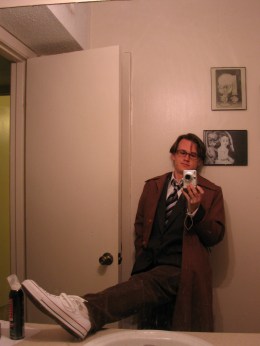
Here is a picture of me dressed up as Doctor Who.

Doctor Me

Can’t seem to find a picture of me dressed as Captain Jack. If you would like, though, readers, do feel free to imagine me in a kitchen dressed as Captain Jack, and you’ll have a pretty good idea of what you’re missing.

I never did quite manage to dress up as Rose. Perhaps, another day.

Once upon a time, my father told me that only people with no imagination possess no fear of the dark. This seemed wise to me at the time, especially as it was said by him as he rolled back into bed after having been sick as a result of chemo treatments and also cancer.

A lot of people describe horrible events as unimaginable, which is silly. What they mean, I think, is that very often the terrors we imagine have more to do with who we are and where we come from than the world we live in. By which I mean, my terrors tend to involve the dark and faces, which is a perfectly reasonable terror for a lonely boy who overheard his parents arguments and whose ancestors sat around a fire, afraid of loud noises and what might wait on the other side of the darkness, but in so many ways, the dark is a far less terrifying place than rolling back into your bed, sick from chemo, and pretty sure that soon you will be dead. But not a lot of people imagine the mundane moments of horror that intrude on our lives. It’s not that they’re unimaginable. It’s just that they don’t live as brightly in our imaginations as the devils and ghouls that more often haunt the darkness that haunts us, inside and out.

Sometimes, when I wake in the middle of the night, for just a moment, a shape, or a face, will peer in from the dark doorway, and a terror will grip my heart that I’m not alone. I know it isn’t real, but it feels real enough. In those moments, I think of what my dad said and the terror loosens and my heart beats a little easier. Something about how he shared his terror helps in those situations, as I hope, very much, that it helped him. Remembering his words means that he’s there in the dark with me, and I’m not alone. Some ghosts are worth not giving up.

Happy Hallowe’en, readers.

ttfn.