trump cheered for carrier deal even as other jobs are trimmed

 
From NYT:

The president-elect warned Gregory Hayes, the chief executive of Carrier’s parent, United Technologies, that he had to find a way to save a substantial share of the jobs it had vowed to move to Mexico, or he would face the wrath of the incoming administration.

“The free market has been sorting it out and America’s been losing,” Mr. Pence added, as Mr. Trump interjected, “Every time, every time.”

 
Also. From The Wall Street Journal (paywall) .

Some economists called Mr. Trump’s actions, including an earlier agreement with Ford Motor Co. to keep some production at a Kentucky plant, an unsustainable intervention in the economy.

“If this is what the Trump team thinks macroeconomic policy is, then they don’t understand the scale of the economy,” said Justin Wolfers, a professor of economics and public policy at the University of Michigan.

The economy currently loses nearly 7 million jobs a quarter through the churn of companies failing, closing or leaving the U.S., Mr. Wolfers said, citing data from the Bureau of Labor Statistics. “Firms contracting or leaving a market is the natural state of business.”

The more pressing issue for the incoming administration would be to find ways to encourage more private job creation, rather than trying to intervene to prevent individual firms from leaving or shutting down.

“Deal-making is not macroeconomic policy,” Mr. Wolfers said. “We should understand it’s politics, not economics.”

 
And. An interview with Mike Pence.

His comments […] suggest that a Trump White House would eschew many of the free-market principles that have guided prior Republican administrations, including injecting itself into the personnel and long-term operating decisions of individual companies.


the future of the american center

 
david brooks writing for a new center

Moreover, the future of this country is not going to be found in protecting jobs that are long gone or in catering to the fears of aging whites. There is a raging need for a movement that embraces economic dynamism, global engagement and social support — that is part Milton Friedman on economic policy, Ronald Reagan on foreign policy and Franklin Roosevelt on welfare policy.


nyt publishes damning, deep look at Trump’s commercial/presidential conflicts of interests, so Trump tweets crazy fake-vote conspiracy


Cory Doctorow writing at Boing Boing:
 

Remember when Donald Trump’s $25,000,000 fraud settlement was a one-day news cycle because we were all focusing on Trump’s insane vendetta against Hamilton?

Well, today, Donald Trump responded to the New York Times’s deep dive into his conflicts of interest – even as a consensus is emerging among constitutional scholars that the exotic emoluments clause will require Trump to sell off much of his business empire – by tweeting a series of bizarre, ghastly-fascinating conspiracy theories about alleged “millions of people who voted illegally.”

 
Here’s a link to the New York Times piece.


unfilmable


Kevin Nguyen, writing at GQ, on adapting Ted Chiang’s short story, “Story of Your Life” into the film Arrival.

Arrival is every bit as sophisticated as its short story origins, and magnificently translated into 2016’s best piece of cerebral science fiction. Amy Adams brings a precise, introspective performance to the film’s hero linguist Dr. Louise Banks. Villeneuve (Sicario, next year’s Blade Runner sequel) conjures intimacy and muted tensions to a film of global scale. But it’s arguably the script by Eric Heisserer that demands the most recognition for how it translates Chiang’s high-concept sci-fi so effortlessly.

Or at least it looks effortless on screen. The script took Heisserer six years to write. To get the rights to the adaptation, he required Chiang’s approval, so he worked on spec—meaning that he worked on it for free, and would only be paid if Chiang sanctioned it after it was completed. “It was the most stressful pitch of my whole career,” Heisserer said. “I lived with it for so many years.”

Listen to Carmen.

And, if you’re interested in Storyological’s discussion of Ted Chiang’s short fiction, listen to that here.

bloatware

Hello, readers.

Of late, I’ve thought about my mom, and how, very often, she took politics so very personally.

She often responded to my sister or I disagreeing with her on one or another political issue as a threat to, sometimes even an erasure of, her identity.

Almost as if our not agreeing with one aspect of her reality, meant we might not agree with the entirety of her reality.

And if we didn’t believe in her reality, then how could we see her? And if we couldn’t see her, how could we love her?

She fought so hard to get us to agree with her.

She fought so hard to get us to see her point of view.

She is not alone in this.

Everybody wants to be heard.

Everybody wants to seen.

Everybody wants to believe their reality is real.

Generally speaking, when people argue they tend to search more for different ways to make the other person see their point of view and less for different ways they might see the other person’s point of view.

And possibly this feeling has increased, over time, along with technology’s long march towards the seemingly celebratory ideal of granting each individual the power to broadcast, and curate, their own reality.

I don’t know.

It certainly seems like, for most of history, and without much trouble, one segment or another of humanity has always excelled at not seeing the reality of one segment or another of humanity.

It’s like the way phones come with certain apps pre-installed.

Evolutionary bloatware, perhaps.

Gather ye bloatware in a folder while ye can, readers, and draggeth it yonder to the furthest pages of your home screen.

Good luck.


ttfn.

be well. do good work. keep in touch.

Hello, readers.

It’s Tuesday.

In other news, it’s lovely to see The Yellow Volume making its way around the webs1. Someone once said that one good thing to do when you grow up is to do good work with good people2. That’s The Yellow Volume. Good work. Good people. And for a good cause, the Clarion Science Fiction and Fantasy Writers’ Workshop.

In other news related to that previous other news, former Clarion graduate, Ted Chiang, once published a story called, “Story of Your Life.” A film based on that story, Arrival 3 opens on Nov 11. A lot of places have already reviewed it. Presumably because they possess time travel technology. Or because they can see the future. Most people can. The future’s right over there. Oh, wait. No. That’s just a squirrel with goggles on. I thought it was the future.

In final news, I reviewed Charlie Jane Anders’ All the Birds in the Sky for Strange Horizons.

In the aftermath of shattered hope and scorched wonder, the novel continues in a more elegiac tone. Sarcasm shuffles off in the face of floods of despair, not to mention the actual floods of climate change which, as foretold in our real world by various sources of non-fiction, science fiction, fantasy, and myth, make an appearance. “Everybody was singing madrigals,” we are told. “Tight staggered harmonies that rang with a lightness that had sharp pieces of melancholy embedded in it” (p. 341). You won’t find a better description of All the Birds in the Sky than that. It is a work of much heart and hope. Some may find the chumminess of its tone saccharine. Some may find the magic rendered with neither enough wonder nor irony. Some may find the science rendered with neither enough rigor nor reverence. Some may be annoyed at the novel’s marriage of conflicts as mundane as burnt casserole with those as miraculous as a witch, floating like a balloon, directing bolts of lightning into the throat of a mecha.

Happy Tuesday, readers.


ttfn.

  1. For example, here and here and here and here. ↩︎
  2. By which I mean this video by John Green, What To Do With Your Life. ↩︎
  3. Not to be confused with The Arrival, the 1996 film with Charlie Sheen, in which shenanigans. ↩︎

an evening with jonathan safran foer

Hello, readers.

It’s Wednesday again. Imagine that.

One Wednesday, not so long ago, Jonathan Safran Foer (author of, among other things, Everything is Illuminated, Extremely Loud and Incredibly Close, and Eating Animals) joined Guardian books editor, Claire Armitstead in conversation at Milton Court. The two touched on topics such as: teaching writing, returning home, wrestling with gods, and the masturbatory possibilities of door knobs. Foer spoke throughout with a quiet assuredness and open-hearted sincerity that I imagine in England might have come across as both extremely loud and incredibly close1. He answered questions as best he could, and when faced with an impossible question, he often answered an entirely different question that, in its own peculiar way, somehow answered the original impossible question.

On more than one occasion, I cried.

After the event, EG turned to me and said, “I see why you love him. Sometimes it felt like I was watching you. Or like you had already seen this and gone back in time and decided to live your life based on what you heard.”

Here are some of the things we heard Jonathan Safran Foer say that night…

On praise and criticism:

I don’t want praise or criticism. I want engagement…when people strongly disagree with my books that’s great. That means we both agree there’s something vital here.

Every review review is bad in its own way. A bad review, I think they’re a schmuck. A good review, I think I’m the schmuck.

On his latest book, I Am Here

I am happier about this book than any other…I finished this book without caring any less about it than I did when I started.

It took eight years to begin to be with these characters.

On caring less over time:

I think that’s one of the big problems with living. Figuring out how not to care less over time. About anything. Inertia moves towards getting used to things and, along with that, a diminishment of concern.

On writing books:

Each book, a voice is telling me that this is the last book you’ll ever write. And by that, I don’t mean that I will stop writing. Or get hit by a bus and die. I mean that the next book will be written by a slightly different version of me.

There’s been a lot of novels that have never happened…My response to not caring about something is not to persevere but to change.

I pursue what makes me feel alive.

There’s an old story that often gets used in philosophy classes. It is the story of a ship that leaves one port and, slowly along its journey to another, every part of the boat is replaced. Now, the question is: Is it the same ship? We think, no it can’t be, because everything about it is different. And we think, yes it must be, because it doesn’t make sense to say that it’s not. I discovered when moving several boxes of manuscripts. One of these manuscripts, fairly thick was titled, The Zelda Museum. I had completely forgotten it. I wrote this book to be my second novel. But somewhere along the way, in the same way as that ship, each piece, each word, was replaced. And that became Extremely Loud and Incredibly Close.

Writing is a leap of faith. A belief that something good will come from pursuing what I care about.

When I turned thirty, I started having birthday parties again. At one, I had a magician. I asked the magician what happened if a trick went wrong. If someone lied about the card they picked or something. This magician that looked at me. He said, ‘I don’t perform tricks. I perform a process.’ That’s how I think about writing.

On truth

I have no idea why some things feel true to some people and not to others.

And it’s not that it just feels right. It’s more than that. It’s that you feel known. Almost exposed. It’s a very intimate relationship between a reader and a book. It’s a singular kind of intimacy.

I could tell you what I think, but I don’t necessarily trust what I think.

There is an enormous category of things you have seen but which you aren’t aware of having seen. An enormous amount of thoughts or feelings which you have thought or felt without being aware that you thought or felt them.

On writing and thinking

How do people who don’t write, think? I walk down the street thinking: Hungry. Unseasonably warm.

I believe the only time I have thoughts are in conversation or when writing. In response, or in creation. Writing creates thought and changes thought.

On ritual

Something that is sustained by choice seems richer than something sustained by habit. But choice leaves you open to choosing to not do it.

On wrestling with god and writing

I wish I was a more ritualistic person.

Max says, Basically we lose everything over time. Except the things we wrestle with. Embedded in that is a kind of hopefulness. Despite all the inconsistencies. The contradictions. It remains in my life.

I don’t have a problem coming up with ideas. I have a problem coming up with good ideas. Ideas that move me.

I want my book to be the news of the world I live in. Not the world outside. The world inside.

I want to be as sure as I can that I am working on what I want to work on. A real and direct and sincere expression of who I am. That I’m not trying to fulfill an idea of myself.

(You move between more and less realistic modes of writing. Fiction and non-fiction. Do you think you’ll settle into one or the other?) Life is long enough. I can do both. I can do neither.

Closing our eyes allows us to open our eyes. In the same way, humor primes sadness, and sadness primes humor.

There’s something about writing and the commitment to a book that is similar to a relationship with a person. There’s the first burst of excitement. And then the learning tapers off. You have to move into a different kind of being.

Every writer I’ve ever met with battles with the question of stopping…The conversation about how to persist inspires me.

In my experience, writers, artists, in general maybe, face two kinds of despair.

  1. I will never make something good.
  2. Nobody can make something good.

The answer to the first is to get back to work. The answer to the second is to go out into the world. To a movie. Or an art show. A concert or a play. Oh yeah. There are good things out there.

There are many reasons, perhaps, listening to Foer moved me as much as it did.

One is that, of late, I have often felt both kinds of despair of which he spoke.

That night helped with both.

Another is that, Donald Trump and his ‘locker room talk’ reminded me of growing up as a boy uncomfortable with locker rooms. Of growing up as a boy uncomfortable, often, with groups of boys of any kind. Of growing up as a boy uncomfortable with being and becoming a man. Of growing up a boy who endeavored not to fantasize about girls he knew because, bless that boy, he worried that using even the idea of someone amounted to a kind of violation2.

Junior year in high school3, I remember accidentally knocking a bit of money off my desk. A girl, on whom I had a crush, bent over to pick it up. I looked away. My friends whispered at me with much indignation. How could I have looked away from the sight on offer? What was wrong with me? I didn’t know how to answer them. But, I felt like they must be right. I felt ashamed. I felt ashamed for not looking. I felt ashamed for being seen as weak. I also felt ashamed for being ashamed. And for having wanted to look, even if I didn’t.

Here’s the thing, I thought about listening to Jonathan Safran Foer say thoughtful things in his quiet, assured, and open-hearted way.

As much as it stressed me out. As much as it may have been needlessly shameful. My boyhood self was right to worry about how he imagined other people.

Most of being human concerns how you imagine yourself and how you imagine others.

As a boy, I found it harder to imagine having sex with girls I liked than with girls I didn’t like because somewhere along the way I became equipped with this crazy idea that wanting to have sex with a woman amounted to reducing her to an object. I can’t imagine where I got such a crazy idea.

It is a failure of imagination that, for many men, the only way they can engage with their desire for women is to imagine women, or themselves, as less than human.

When people talk about toxic masculinity this is what they sometimes mean.

I have, as happens, grown older. And, perhaps, I have grown wiser.

I haven’t, as of yet, become a man.

I am still a boy growing up afraid of becoming something unrecognizable.

I am still a boy that believes the thoughts we think, and the words we say, even in private, especially in private, affect who we are. How we are. In public as much as in private.

Because we are always in the company of ourselves, and what we choose to imagine about ourselves, and what we choose to say with and to ourselves, affects how we see, and therefore how we live in, the world.

As Vonnegut said, “We are what we pretend to be, so we must be careful what we pretend to be.”

Pretend well, readers.

ttfn.
  1. see_what_you_did_there_doctor_who↩︎
  2. There was, also, a consideration that somehow after I died, and they died, and we were all in heaven, they would know that I had masturbated to them. I no longer have this particular fear. ↩︎
  3. For Brits, this would be, I believe, the first year of your N.E.W.T.S., erm, A-levels. ↩︎

42 things to keep in mind concerning mancunicon 2016 in case you find yourself traveling back in time to save humanity from hyperintelligent shades of blue or something else equally silly

  1. You don’t need to go to the opening ceremony. It is fun seeing everyone introduced, though. And feeling like you’re there at the start of something. Like now. With this list.
  2. Don’t wait to go to that panel you’re really excited about or possibly features your partner. Go to it. Now. I don’t care if it’s not until tomorrow.
  3. There are many things to learn at the TRANSCENDING THE GENRE AND OTHER POLITE INSULTS, such as, among other things: stickers are cool and worthy of discussion; astronauts equal SF; the closer SF gets to dreamy, the closer it gets to being considered literature; it’s possible SF is less a genre than a mode or a way of thinking; Flaubert’s main rule for novels? NO HEROES OR MONSTERS; books begin with a question.
  4. Whiskey or wine is best. For all you may think that you want to try the cider it will only end in sadness.
  5. Remember to examine anything you think might be a ghost with your glasses on. Trust me.
  6. The panel on Comma Press will be cool because you will learn that Comma Press exists and is connected to that whole MUNDANE SF thing what involves Geoff Ryman. Geoff Ryman continues to be very tall.
  7. Niall Harrison is an excellent person to whom to direct questions. He knows a lot of stuff about a lot of things. If you get a chance you should read a lot of Ian McDonald before attending the con, so that you also seem to know stuff.
  8. Miss Fisher’s Mysteries. Watch it. If nothing else so you understand what people are talking about on that panel FABULOUS HATS, FAST CARS, & FEMINISM. Also. Consider whether or not the heightened reality of Miss Fisher which might attract SF people, might also be what attracts such people to Jane Austen.
  9. There are too many amazing things to read. Luckily THE YEAR GONE/THE YEAR AHEAD panel will tell you what’s most important. You should read this post by EG Cosh after the con. It will help you remember.
  10. It’s still too many, but that’s okay. At least, you won’t get bored before you die. Well. Unless.
  11. When in doubt write it down. Fuck it. Write it all down.
  12. Particularly everything Sarah Pinborough says. Well. Except that. You probably didn’t need to know that.
  13. Do not worry about moderating.

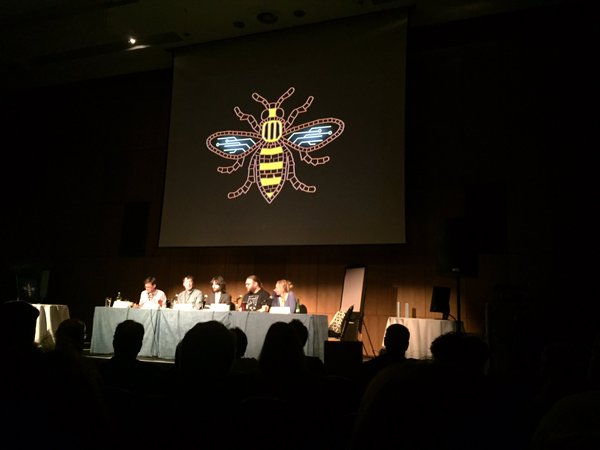
    CejbaSKWIAEsS8q

    I know it is the first panel you’ve ever been on and you’re moderating it and Sarah Pinborough, a guest of honor, is on there, along with Martin Wisse, Glyn Morgan, and Martin Petto, all seemingly rather smart and experienced con-going SF people. I know your stomach will cramp. I know you’ll feel sick. I know that you will never not be scared and nervous, really, about these sorts of things. You still get scared sometimes to talk to strangers or even friends. I know it seems crazy to be this nervous over something that doesn’t have sharp teeth or eyes on the inside of their hands. Its okay. You have learned how to deal with this before. Smile. Remind yourself everyone is afraid. We’re all pretending. Besides. It might be fun. It will be, in fact. All you have to do is ask questions, anyway. These people will take care of the rest. They are smart. And hilarious. Plus you have that panel on grief and death to look forward to, so that’ll be fun.

  14. I don’t know why people think when you say does anyone have any questions that what you’re really saying is are there any comments and suggestions. But they do.
  15. Don’t worry about speaking up about this. It will work out okay.
  16.  


  17. You know that woman that haunts your dreams? The faded one in the white dress standing in the window of the photograph hanging over your hotel bed. She is actually a large flower pot sitting on a balcony. See earlier point on wearing your glasses.
  18. Some smart things people will say during the panel: IF YOU DON’T SCREAM YOU’LL LAUGH. Sarah Pinborough-“If you give people the light, they’ll follow you further into the dark.”; Charlie Stross – “Sometimes going for a profound sense of unease is better than going for horror.”
  19. Some things people will recommend during this panel – Inside #9, League of Gentlemen, Dr. Strangelove, Shaun of the Dead.
  20. Is concrush a word? Let’s go ahead and say yes. Try to limit concrushes to less than five.
  21. Before the FOOD, GLORIOUS FOOD panel, you should probably eat. But you won’t. You’ll probably think it’s a good idea to go in hungry so that you can really LIVE THE MOMENT. Well. Whatever. Do what you want. Just keep in mind that when people are saying smart things about the rituals of food or how SF is a literature of the mind, perhaps, more than the body, you will be thinking about how good a papadom would be about now.
  22. Did you know Babylon 5 has a cookbook? It does. So does Moomin. You will find this out at the FOOD, GLORIOUS FOOD panel. You will learn other things, too, such as: the best writing about sex and food is about what’s happening in the character’s head; food is memory; stew gets a bit of a bad rap; Chaz has a turtle that roams free about the house; people remember the things they’re interested in, and, at one time, tea was thought to be very, very bad as it encouraged women to get together and gossip.
  23. Actually, the only gluten free option at Dogs n’ Dough is a hot dog without the bun.
  24. Luckily there’s an Indian restaurant nearby. It’s delicious. And there’s papadom! You might want to ask for that bread and rice again, though.
  25. Hey. You. Yes, you. You don’t need so many notes for that panel you’re on called THE DEEPER THE GRIEF, THE CLOSER TO LIFE, with Neil Williams, Alison Sinclair, Sarah Pinborough, and Kev McVeigh (m). Already know you that which you need. You’re an orphan remember? Well. Recently an orphan. Does that still count? I think that still counts.
  26. Besides. If you’re too attached to what you already think, or want to say, how will you be able to respond in the moment?
  27. For example referencing Babylon 5. That show is awesome. You should totally reference it more often.
  28. Remember to write down what Sarah Pinborough references after saying that your reference to Babylon 5 had sufficiently lowered the bar such that she could reference that other thing you can’t remember.
  29. Or you could ask EG. And she will remind you later.
  30. It was the Face of Bo.
  31. The thing that you will want to take away from THE DEEPER THE GRIEF…is that when you get people together to talk about death mostly what people talk about is how it feels to be alive. It isn’t scary. It’s funny. Sometimes sad. Occasionally true. I don’t know that you need to tell everyone you’re an orphan in your introduction, but go ahead. I can see it delights you.
  32. Terry Pratchett did us a great kindness in the character of Death. It allowed us to be less afraid. Death was warm. Death was funny. Death was real. GK Chesterton has this thing about how fairy tales are more than true not because they tell us dragons are real, but because they tell us dragons can be defeated. The thing I love about Death in Terry Pratchett, and in Sandman, is that those stories don’t just tell us death is real, they tell us that Death is someone we can have a relationship with.
  33. I realize sometimes that this list loses its place in time. That is for the sake of realism.
  34. Other things you will learn on the grief panel: we all lose parts of ourselves; you don’t know people not really but sometimes when they die people bring you pieces of them that you’ve never seen and it can be scary and it can be amazing. Just like with still alive people. Just like with cons.
  35. Part of traveling through time is that you can say things like this: Everyone here is going to die. But not today.
  36. Also. Sarah Pinborough does not care about your touching story concerning The Force Awakens. You might want to rethink mentioning it. But, then again. Go ahead. It’s hilarious.


  37. Enjoy your wake with Sarah and Kev after the grief panel. It is a weird sad funny giddy moment. It’s also Sarah’s birthday. Pay attention to everything everyone says. Even you.


  38. I could write more. But this was it for me. The grief. The wake. The stories. Laughs. That was my closing ceremony. That was the best goodbye.
  39. Until next time, of course. When you hopefully see these people again.
  40. Try not to die.
  41. Don’t be afraid.

hitherto unknown

Hello, readers.

Some things for you, on this Tuesday, the first of March.

  1. The Colbert Show’s precise lampooning of Facebook’s Reactions. Far more precise, in particular, when compared to my earlier emoting.
  2. Anthony Lane writing of the Dali-esque Oscars, including this bit at the end on the matter of money and influence.

    Take the combined global earnings of the ten films that starred the nominees for Best Actor and Best Actress in a Leading Role, all of whom are white, and you arrive at the rough sum of $1,316,000,000. Now put that next to the box-office takings of “Star Wars: the Force Awakens”—$2,048,000,000. That is quite a chasm, and it tells us that, if we lay aside for a moment the admittedly vexing question of prejudice in the awards system, and concentrate purely on the numbers, more people around the world went to see a movie that was fronted (at times, indeed, pretty much held together) by a young black man and a young woman, both hitherto unknown, than went to see all the films that were—with justice—lauded and garlanded last night. J. J. Abrams, the director of the new “Star Wars,” didn’t just think about diversity, or cry it up as a good thing; he put it into play. He realized, as George Lucas failed to do, that racial equality was not just an option but a laughably clear obligation in a galaxy far, far away

  3. Books are the only real magic. I have nearly finished She Came to Stay by Simone de Beavoir, and during one scene in a barn, I thought about how love can feel like you’re standing on the edge of a precipice and across from you, on the other side, there is the person you love, waiting for you. All you have to do is leap. But what if you fall?
  4. Sometimes it is scary how moody my moods can be. How my mind seems to have a mind of its own. It is also, of course, quite wonderful. This is how magic works, after all. Things appearing and disappearing by some mechanism cloaked from view. You know it’s a trick, but you enjoy pretending.


Happy Tuesday, readers.


ttfn.